
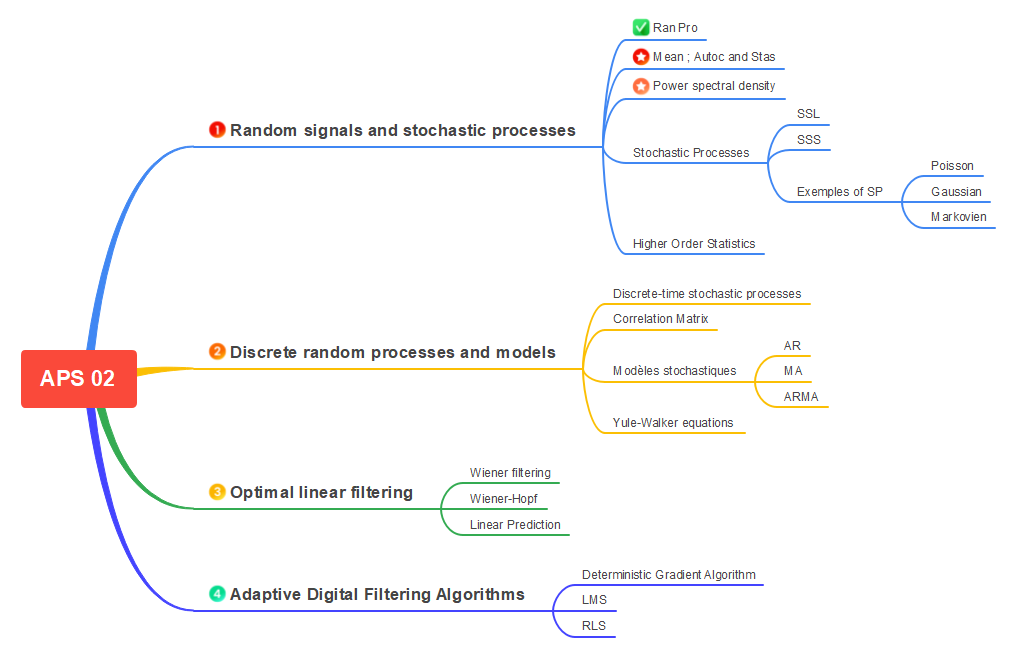
This online course, titled "Advanced Signal Processing for Electronic Instrumentation," aims to equip students with the theoretical and practical skills required to analyze, model, and interpret complex signals in modern electronic systems. It covers key concepts such as:
· Digital signal processing methods (filtering, transforms, time-frequency analysis).
· Advanced techniques for analyzing noisy or non-stationary signals (wavelets, adaptive filters).
· Applications of these methods in electronic instrumentation (smart sensors, measurement systems, data acquisition).
· Use of software tools (MATLAB, Python, LabVIEW) for simulating and implementing algorithms.
The course incorporates real-world case studies from industries (embedded systems, biomedical instrumentation, industrial control) and emphasizes innovation in the context of digital transformation (IoT, cyber-physical systems).
2. Target Audience
This course is primarily intended for:
· 1st-year Master’s students in Electrical Engineering, specializing in Electronic Instrumentation or Embedded Systems.
· Professionals seeking retraining or skill enhancement in electronics, automation, or metrology.
· Prerequisites:
o Basic knowledge of signal processing (Fourier transforms, sampling).
o Foundational understanding of analog and digital electronics.
o Familiarity with programming (Python, MATLAB, or C).
3. General Objectives
By the end of this course, learners will be able to:
- Understand Theoretical Foundations:
o Master mathematical tools for analyzing deterministic and stochastic signals.
o Identify limitations of classical methods and propose tailored solutions (e.g., Kalman filtering for noisy signals).
- Develop Technical Skills:
o Design and implement signal processing algorithms for instrumentation applications (e.g., sensor noise reduction, feature extraction).
o Use specialized software to simulate and validate models.
- Apply Knowledge to Real-World Problems:
o Analyze signals from complex electronic systems (e.g., biomedical signals, mechanical vibrations).
o Optimize performance in data acquisition and processing systems.
- Prepare for Industrial and Academic Challenges:
o Explore connections between signal processing and emerging technologies (embedded AI, edge computing).
o Collaborate on interdisciplinary projects (electronics, computer science, automation).
Pedagogical Approach:
· Video lectures enhanced with interactive diagrams.
· Virtual practical sessions (simulations, analysis of real datasets).
· Individual or group projects to reinforce learning (e.g., designing an ECG signal monitoring system).
This course bridges academic theory and industrial practice, preparing students to innovate in a rapidly evolving technological landscape.
- Enseignant: ramadhan masmoudi